
Nov 7, 2026

Brazil shuts down its betting market: what operators lost and where they can go
A Smart Social analysis with data from Blask
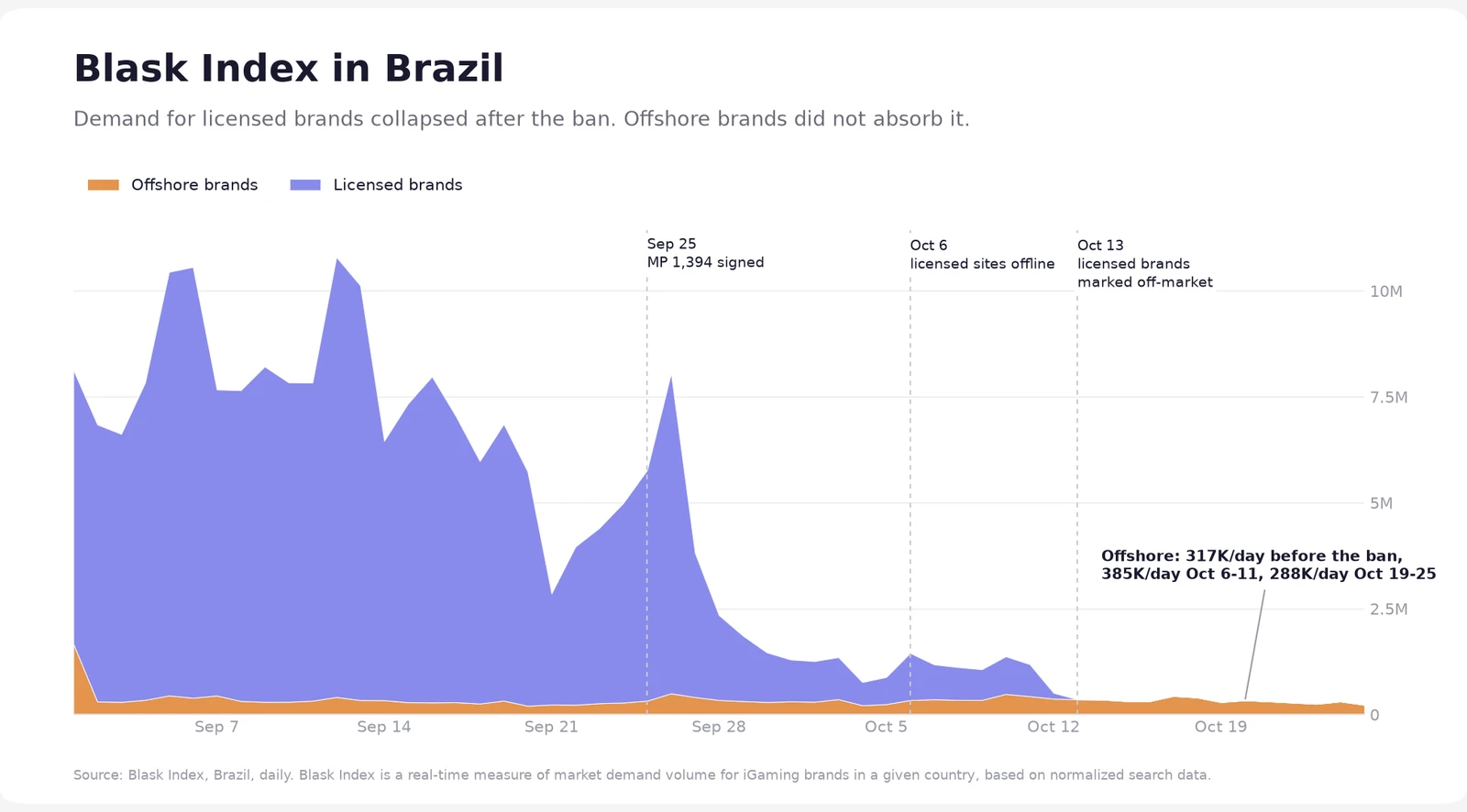
In the first week after licensed betting sites went offline, demand for their brands in Brazil fell by 88%. Between September 2 and 24, before Provisional Measure 1.394 banned fixed-odds betting on September 25, licensed brands averaged 6.9 million searches a day on the Blask Index. Between October 6 and 11, they averaged 846,000. One month after the measure, Brazil’s Blask Index, which by then counted only brands still operating in the country, was 96% below its pre-ban level.
The 85 federal licenses, which cost BRL 2.55 billion in fees, were extinguished on October 25, 30 days after the measure was published. The market had operated for 21 months, and the licenses ended in month 22 of a 60-month term, with no refund. By Blask’s estimate, extrapolated from the GGR licensed operators reported in the first half of 2026, the licensed market lost about BRL 270 million in GGR between September 25 and October 5.
This article, built on exclusive Blask data, sets out what the regulated market built in 21 months, what was lost with the ban, and which markets can take in the operators and affiliates that now need to redirect their business.
About the data. The Blask Index measures demand for iGaming brands based on normalized search data (Google Keyword Planner and Google Trends). It does not measure revenue, deposits, player counts or traffic. After a ban, part of the activity moves to bookmarks, mirror sites and Telegram links, so the post-ban Index is best read as demand for named brands rather than as the total amount of betting. CEB (Competitive Earning Baseline) is a model-based revenue estimate, not reported GGR. Panel figures come from Blask’s opt-in panel; the Indian panel cited below has 657 people. CEB figures are reported in USD. Official Brazilian figures, and Blask estimates derived from them, are in BRL. We keep each in its original currency and do not convert between them.
What the regulated market had built
The regulated market opened on January 1, 2025. Within one month, licensed brands already accounted for 92% of Brazilian demand. That fast uptake shows most of the sector was ready to operate under federal rules as soon as they took effect.
Demand grew in the months that followed. The monthly Blask Index rose from 180.7 million in January 2025 to 240.4 million in April 2026, the highest point in the series. The number of brands tracked by Blask went from 442 to more than 510.
The market also became more formal. By Blask’s estimate, the share of revenue tied to licensed brands rose from 91.3% in January 2025 to 96.9% by mid-2026. The market’s average monthly CEB was about USD 597 million in 2025 and USD 883 million between January and August 2026.
Official figures point in the same direction. CEB is a modeled revenue benchmark and measures something different from the GGR operators report, so the two are best read together for direction: both show the market growing into 2026.
- Licensed operators reported BRL 20.07 billion in GGR in the first half of 2026, about 15% above the same period of 2025.
- Federal revenue from betting taxes, licenses and grants reached BRL 9.95 billion in 2025 and BRL 9.9 billion between January and August 2026, close to the full-year 2025 total in eight months.
- The sector came to fund a significant part of Brazilian football. In 2026, 14 of the 20 Série A clubs had a betting brand as their main sponsor. According to an EY survey, betting brought BRL 1.14 billion into Série A clubs in 2025, 7.9% of their combined revenue. At Corinthians, that share reached 17.3%. At Flamengo, 12.7%.
- The regulated market also built a player protection framework. More than 1.2 million Brazilians had signed up for self-exclusion from licensed sites by August 2026.
Demand had cooled in the months before the ban. The monthly index dropped 18.8% in July and 11.5% in August, a decline that coincided with the end of the World Cup. By early September, daily demand was recovering. The September 1 to 24 average of 7.26 million searches a day was above August’s pace of about 5.5 million a day.
What was lost with the ban
Demand. The daily Blask Index for all betting brands, licensed and offshore, averaged 7.26 million from September 1 to 24. It peaked at 8.05 million on September 26, the day after the measure, possibly linked to a rush for information about withdrawals, and fell to 1.3 million by October 1. For licensed brands alone, the September 2 to 24 average of 6.9 million dropped to 846,000 a day between October 6 and 11, when their sites had gone offline, a fall of 88%. From October 13, Blask marked licensed brands as off-market, and the Index for Brazil counts only brands still operating there. Between October 19 and 25, it averaged 288,000 a day, 96% below the pre-ban level. Blask’s panel data point the same way: on October 1, visits to .bet.br sites were 74% below their pre-ban level.
Licenses and revenue. BRL 2.55 billion in license fees with no refund or compensation, plus about BRL 270 million in GGR that went ungenerated in the first ten days, according to a Blask estimate extrapolated from licensed operators’ reported GGR.
Sponsorship and media contracts. The measure set October 5 as the deadline to remove advertising and sponsorship materials, and licensed sites and apps had to go offline by October 6. Multi-year contracts with clubs and media outlets lost their basis.
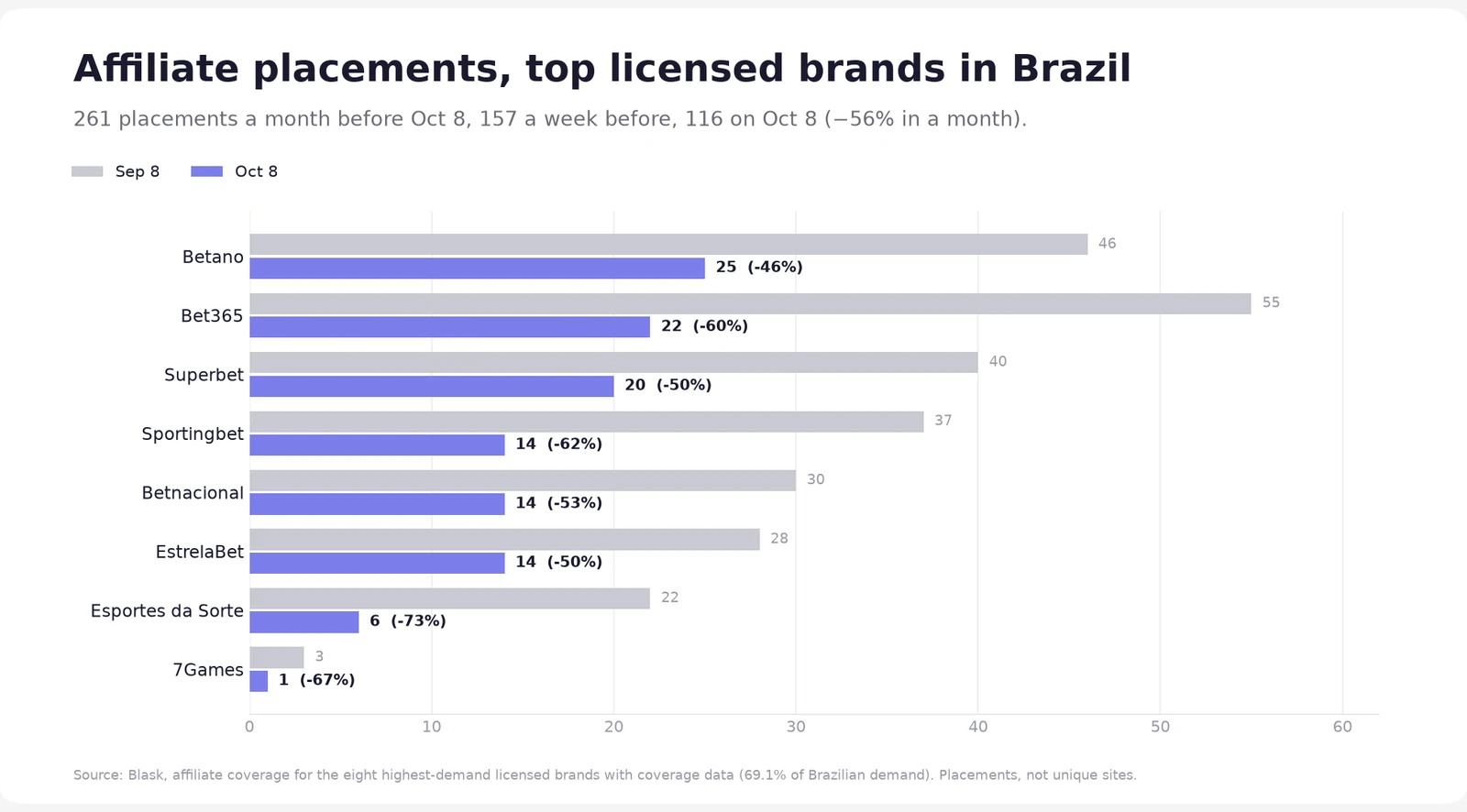
The affiliate network. The eight licensed brands with the highest demand and available affiliate data accounted for 69.1% of Brazilian demand. Their placements on affiliate sites fell from 261 to 116 in one month, a 56% decline. In the first week after the measure alone, the drop was 26%. Brands without a Brazilian license were also hit, which suggests affiliates are cutting their exposure to the market as a whole.
A verified player base. In 2025, 25.2 million people bet with licensed operators, all through verified accounts with deposit limits and access to the self-exclusion registry. That base no longer exists as a regulated channel.
Where the remaining demand went
The share of brands without a Brazilian license rose from about 4% of demand before the ban (4.4% on average from September 2 to 24) to 28.5% on October 8. The increase is mainly explained by the collapse of the total. In absolute terms, offshore demand moved within a narrow range: it averaged 317,000 a day before the ban, rose to 385,000 in the first week without licensed sites (October 6 to 11), and fell back to 288,000 between October 19 and 25, 9% below its pre-ban level.
Blask’s panel shows another signal. The reach of unlicensed sites stayed within 11% of its pre-ban level, while the reach of licensed sites fell 74%. In the 90 days before the measure, 57% of Brazilian gamblers in the panel had already visited an unlicensed site.
That 57% can look at odds with the 4% offshore share of search, but the two figures measure different things. The 4% counts searches for named offshore brands. The 57% counts actual visits in the panel, and many of them went to mirror domains with no brand in the address, which never show up in brand search. The offshore audience was already larger than search suggested, and the shift after the ban is less visible in search for the same reason.
The illegal market also responded quickly. In the first five days, authorities requested blocking for 5,209 domains. On the private side, an industry monitor identified 6,401 new unlicensed sites in the week around the measure (September 22 to 28), and the LegitBet monitoring tool had logged 60,477 suspicious addresses by October 27.
India, which banned real-money online gaming in August 2025, offers a reference. Three months after its ban (September to November 2025), 63% of the 657 Indian gamblers in Blask’s panel were still visiting betting sites, and 61% had visited an offshore site. Domestic real-money sites lost 73% of their reach. To project Brazil, Blask compared India’s rate with a Brazilian control group over the same period, with no ban, in which 73.5% stayed active. That ratio, about 86%, applied to the 25.2 million people who bet in Brazil’s legal market in 2025 gives roughly 21.6 million Brazilians who may keep betting, mostly on offshore sites. This is a projection drawn from a small panel in another country, not a measurement of Brazil.
The most sensitive figure for the country comes from this shift: offshore operators do not follow the self-exclusion registry. A player who asked to be blocked in the regulated market has no such protection outside it.
Where operators can go
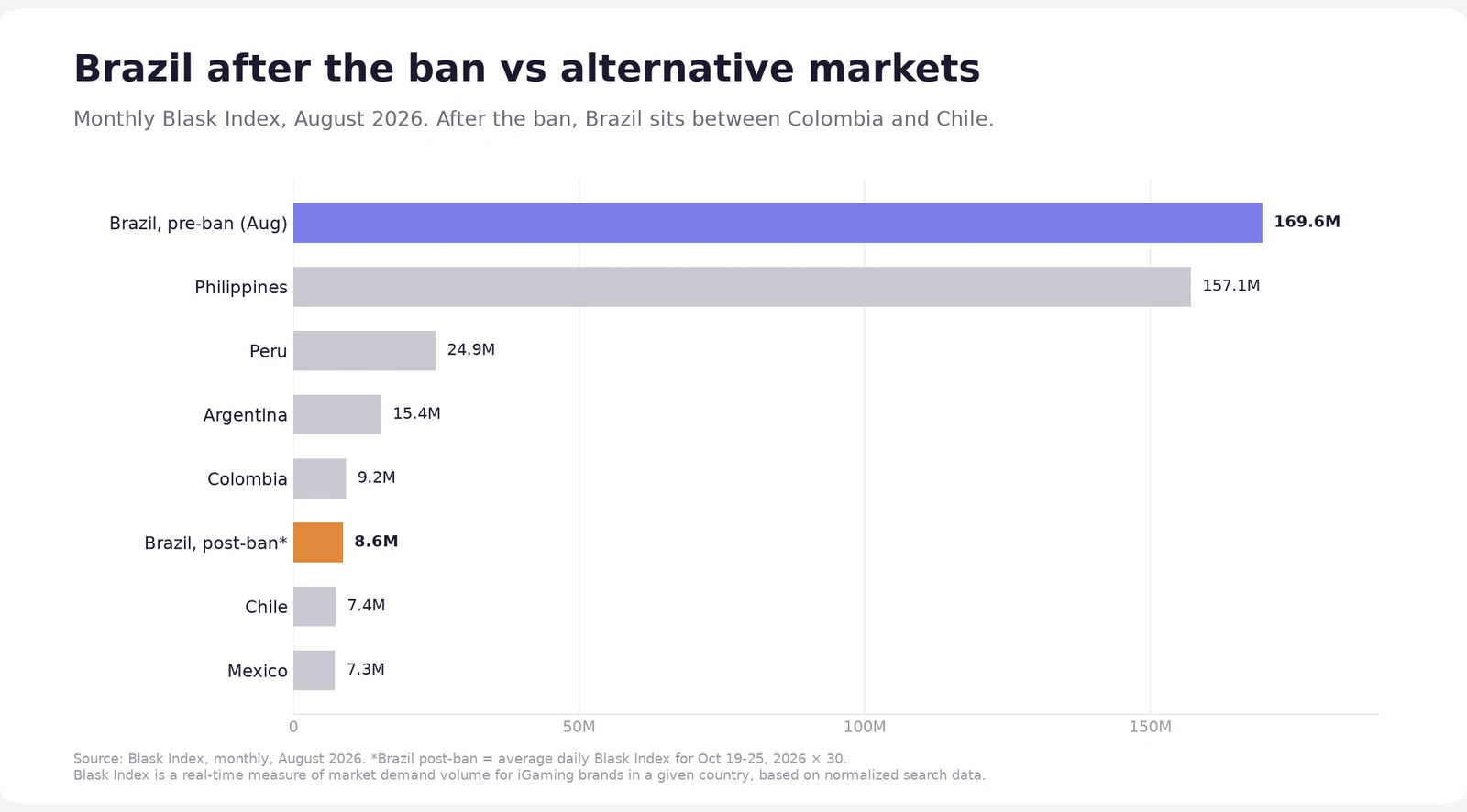
The first filter is regulation. The comparison below covers markets with local licensing in force, plus Chile as a market to watch. Figures are from the August 2026 Blask Index, the last full month before the measure. For each market: August demand, year-to-date growth (January to August), share of the top 3 brands and offshore share.
- Brazil (reference): 169.6 million; +5.6%; top 3 at 51.7%; offshore at 4.9%.
- Philippines: 157.1 million; +212.7%; top 3 at 55.6%; offshore at 16.0%.
- Peru: 24.9 million; +31.8%; top 3 at 77.0%; offshore at 0.3%.
- Argentina: 15.4 million; +46.4%; top 3 at 60.7%; offshore at 14.5%.
- Colombia: 9.2 million; −7.7%; top 3 at 82.1%; offshore at 6.7%.
- Chile: 7.4 million; +43.0%; top 3 at 72.9%; offshore at 100.0%.
- Mexico: 7.3 million; +19.4%; top 3 at 46.1%; offshore at 7.5%.
What the data show:
- Philippines. The only market with volume comparable to pre-ban Brazil: 157 million versus 170 million in August. Demand went from 40 million in January 2025 to 157 million in August 2026, and the 16% offshore share points to competition outside the licensed system. It is also the market with the highest regulatory risk on this list. Senate Bill 47, the Anti-Online Gambling Act, which would ban domestic online gambling, is pending in the Senate’s Committee on Games and Amusement. In August 2025, after e-wallets were ordered to cut their links to gambling platforms, PAGCOR reported that online gaming transactions had fallen about 50%, and the regulator has since tightened advertising rules. The cause of the search growth has not been identified, and search demand and payments measure different points of the funnel, so operators should track both before committing budget.
- Peru. The market is regulated and its offshore share is almost zero (0.3%). The 31.8% year-to-date growth was inflated by a peak in June and July, and high concentration (77% in the top three brands) makes entry harder.
- Argentina. Grew 46.4% year to date. Licenses are granted by province, which requires a separate strategy for each jurisdiction.
- Colombia. The oldest regulated market in the region, but demand fell 7.7% year to date and the top three brands hold 82.1%. It is the hardest entry environment on the list.
- Mexico. The least concentrated market (46.1%), with 19.4% year-to-date growth, possibly helped by the 2026 World Cup.
- Chile. Demand grew 43% year to date, but 100% of it goes to brands without a local license, because Chile has no online licensing regime yet: the bill is still in the Senate, and a 2025 Supreme Court ruling ordered internet providers to block offshore betting sites. Worth preparing for, not entering yet.
None of these markets, except the Philippines, came close to Brazil’s pre-ban scale. After the ban, the picture reversed. Between October 19 and 25, Brazil’s demand averaged 288,000 searches a day for brands still operating there, roughly 8.6 million a month. Unlike the other markets on the list, that figure no longer includes licensed brands. Compared with the August figures above, that puts Brazil at about a third of Peru, below Argentina and Colombia, and only slightly above Chile and Mexico.
So far, there is also no sign that demand for the brands that operated in Brazil has moved to other countries. Blask compared Brazil’s 30 largest brands in the 13 days before and the 13 days after the measure, across the six markets above plus the UAE, and found no clear pattern. This means the signal is not visible in the data yet. It does not mean migration will not happen.
What to do now
This section is general market guidance, not legal advice. Each operation should confirm its position with legal counsel in Brazil and in each target market.
For operators
- Do not serve Brazilian players from abroad. Fines reach BRL 2 billion per infraction, with suspension of activities. Alongside the measure, the government sent Congress a bill that would create betting-related crimes, with prison terms of up to six years plus fines for operating betting illegally. If it passes, the risk becomes personal criminal liability, not only a corporate fine. If the market reopens, the reputation built during the regulated period is also likely to weigh on new authorizations.
- Preserve data and governance without promotional communication. Keep player records as the law requires, keep honoring self-exclusions and deposit limits, and make no marketing contact with players in Brazil, which the advertising ban prohibits.
- Follow Congress and the Supreme Court. Congress has 60 days, extendable by 60, to vote on the measure, and the clock stops during the congressional recess; the first period ends on November 23. The measure received more than 90 amendments, ranging from restoring the extinguished licenses to keeping sports betting while banning online casino. At the Supreme Court, the industry associations ANJL and IBJR asked for the measure to be suspended on September 28, the broadcasters’ association Abert followed on October 1, and Justice Luiz Fux is the rapporteur. On October 25, President Lula, who signed the measure, was re-elected. Congress, not the election, will decide the measure’s fate, and the outcomes range from the full ban standing to a narrower regime that keeps sports betting. Operators should plan for the ban to stand while preparing for a partial reopening.
- Choose markets by scale, ease of entry and regulatory risk. The Philippines offers scale, but carries a pending bill that would ban domestic online gambling. Mexico offers lower concentration. Peru and Colombia require competing with established leaders. Argentina requires a license per province.
- Adjust expectations. The regulated Latin American markets combined do not replace the volume Brazil had. Reallocating budget needs to account for lower returns per market and higher local operating costs.
For affiliates
- Review your inventory. Links are already coming down: placements for the main brands fell 56% in one month. Keeping pages live for a Brazilian audience is a legal risk.
- Do not swap licensed brands for offshore ones. Promoting unlicensed sites to Brazilians is betting advertising, also banned by the measure. The government’s companion bill would also make promoting illegal betting a crime in its own right.
- Diversify language and geography. Spanish-language content for Latin America’s regulated markets and English-language content for the Philippines opens room outside Brazil, as long as each page follows the advertising rules of its destination country. In the Philippines, that includes tracking the Senate bill and PAGCOR’s advertising rules.
What remains open
In 21 months of operation, Brazil built a market with 97% of revenue in licensed brands, billions of reais in tax revenue, a player protection framework and a media and sponsorship ecosystem. The measure ended that cycle in a matter of days, and the licenses expired on October 25. With Congress still to vote, challenges pending at the Supreme Court and a re-elected government that signed the ban, operators and affiliates need to plan their exit from Brazil while keeping track of a possible reopening.
Replanning markets requires local operations in each one
Moving budget between countries is not only a media decision. Each market has its own licensing and advertising rules, a different level of concentration and an audience that responds to different channels. At Smart Social, we follow this shift closely. We run campaigns in more than 25 countries, with more than 1,000 creators and compliance guidelines set for each market. That structure has already generated more than 65,000 first-time depositors for the brands we work with.
Disclosure: Smart Social runs campaigns in several of the markets discussed in this article.
Let’s talk
If your operation is assessing where to take the investment that was in Brazil, we can help compare markets and build an entry plan with predictable delivery. Talk to our team.
Sources: Blask (Blask Index, CEB, opt-in panel and projections), with official and press figures cited in Blask’s report and in the Brazilian and Philippine press. Data through October 27, 2026. CEB values are model-based estimates and do not replace operators’ financial reports or regulatory data.